Eyes Never Lie: Predicting Attention with EyeQuant with Julia McGowan

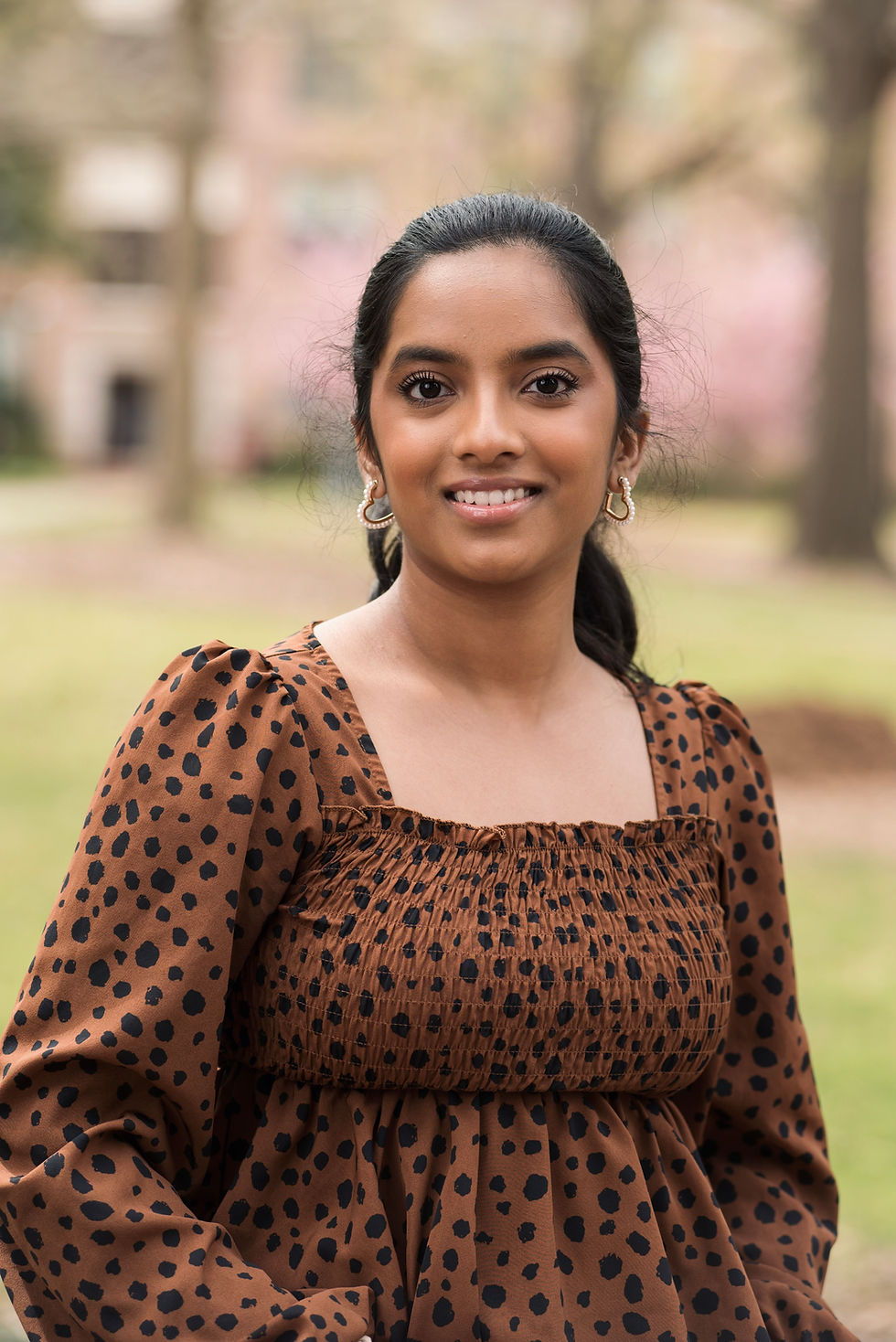
Hi! My name is Julia McGowan, and I am a senior from Apex, North Carolina, majoring in Psychology and Data Science with a minor in Hispanic Studies. This fall, I am interning at EyeQuant, a software-as-a-service company that uses a proprietary artificial intelligence model to simulate and predict how the human visual system processes information, allowing companies to evaluate websites, advertisements, product packaging, and much more without requiring live traffic or user testing. The research behind the software was first conducted at CalTech and the University of Osnabrück in Germany, and the company is now headquartered right here in North Carolina at Research Triangle Park.
My work this semester centers on a deceptively simple question: what do people’s eyes gravitate toward in video advertisements? Our data comes from an eye-tracking study in which participants viewed pairs of images pulled from real video ads while researchers tracked which one captured their attention more. My job is to build a reliable way to score how attention-grabbing each image is, then to predict that score from the image alone. Day to day, that means data cleaning and fitting statistical models to score how attention-grabbing a given image is. I have been thoroughly impressed by what EyeQuant’s software can do, and I am excited to contribute to expanding its abilities.
The study of psychology is where I started, and it is what ties all of this together. Over the past three years at Carolina, I have become especially interested in psychological approaches that use quantitative methods to strengthen the precision and validity of clinical research. I am also drawn to perspectives that challenge the latent construct view, the idea that a disorder is a single underlying “thing” causing its symptoms, and instead examine the mechanisms that different disorders share.
That interest began in Dr. Jon Abramowitz’s Anxiety and Stress Lab, my first research position at UNC. There, I contributed to meta-analyses and ran human subjects through behavioral research tasks. I am now completing a senior honors thesis in his lab that examines how a novel OCD measurement scale relates to the field’s gold standard. Rather than relying on total scores alone, I am using network analysis to look at how individual symptoms connect to one another. The hope is to learn whether the new scale captures the structure of OCD in a meaningful way, which matters because the way we measure a disorder shapes how we study it and ultimately how we treat it.
I also volunteer in Dr. Anna Bardone-Cone’s Eating Disorder and Body Image Lab, where I have had the privilege of contributing to several incredible studies on eating disorder occurrence, risk factors, and recovery in underrepresented populations. Seeing how much of the eating disorder literature has centered on a narrow slice of the population made me appreciate that more inclusive research leads to better science and better care for the people who have long been overlooked. Working across two very different labs has reinforced for me that rigorous methods and compassion for the people behind the data are not in competition, but that they depend on each other.
That brings me to what has been on my mind lately. This project, and stories that have come up in my labs about the effects of AI use on mental health, have shown me how closely technology and human psychology are intertwined. At EyeQuant, I see how powerful AI can be when its built on a real understanding of how people perceive and think. In the labs, I have heard about the other side: people who turned to AI tools in vulnerable moments and were not well served by them. Seeing both of these realities at once has shaped what I want to do next.
After graduation, I hope to work at the intersection of psychology, data, and AI governance, helping ensure these systems are built and regulated with human wellbeing in mind. I am still exploring the best route here, though I currently plan on attending law school and pursuing a career that pairs rigorous methods with real-world impact. Eventually, I would love to find a way back to teaching, because the mentors who welcomed me into their labs changed the course of my time at Carolina, and I would like to do the same for someone else.
I am incredibly grateful to Felix Molitor and Kramer Reeves for welcoming me into EyeQuant and for their mentorship throughout this experience. I would also like to thank Dr. Steven Buzinski and Richie Gray for their guidance, support, and leadership of this incredible program. I am so excited to continue learning from my mentors and the rest of my Gil cohort & to see where the rest of this semester takes me!


Comments